
Scissor lift training guide for OSHA compliance 2026
Scissor lift accidents cause serious injuries and fatalities across warehouses and construction sites every year. OSHA mandates comprehensive training on scissor lift hazards to protect operators and meet legal standards. Without proper training, workers face fall risks, collision hazards, and equipment failures that jeopardize safety and regulatory compliance. This guide walks you through OSHA requirements, preparation steps, training execution, and verification processes to build a robust scissor lift safety program that protects your team and satisfies regulatory obligations.
Table of Contents
- Understanding OSHA Requirements For Scissor Lift Training
- Preparing For Effective Scissor Lift Training
- Executing The Scissor Lift Training Program Safely And Effectively
- Verifying Training Outcomes And Maintaining Compliance
- Enhance Your Scissor Lift Safety With Professional Training
- Frequently Asked Questions
Key takeaways
| Point | Details |
|---|---|
| Training impact | Proper scissor lift operator training reduces workplace incidents by 40% through hazard awareness and safe practices. |
| OSHA mandate | Federal regulations require training on hazard recognition, safe operation procedures, and fall protection protocols. |
| Fall protection | Operators must understand stabilization, positioning, and personal protective equipment to prevent the most common accidents. |
| Authorization | Only trained and documented personnel may operate scissor lifts in OSHA-compliant workplaces. |
| Documentation | Employers must maintain training records proving operator competency and regulatory compliance. |
Understanding OSHA requirements for scissor lift training
OSHA classifies scissor lifts as mobile supported scaffolds, which determines fall protection protocols and operational guidelines. This classification means operators face unique hazards compared to other aerial work platforms. Understanding this framework helps you design training that addresses regulatory expectations and real-world safety challenges.
Training must cover hazard recognition, operation, material handling, and worksite-specific risks. Employers bear responsibility for ensuring every operator demonstrates competency before authorization. This includes pre-operation inspections, load capacity limits, terrain assessment, and emergency shutdown procedures. Your training program should address each element with practical demonstrations and written assessments.
Compliance reduces workplace incidents and protects your organization from citations, fines, and legal liability. OSHA inspectors review training documentation during site visits, looking for proof that operators received instruction and passed competency evaluations. Missing or incomplete records trigger violations that carry financial penalties and reputational damage.
Only trained and authorized personnel may operate scissor lifts under federal standards. This requirement means you must verify training completion before granting access to equipment. Consider these essential training components:
- Pre-operation inspection procedures and daily safety checks
- Load capacity calculations and weight distribution principles
- Fall protection systems and personal protective equipment requirements
- Emergency descent protocols and equipment shutdown procedures
- Worksite hazard assessment and obstacle avoidance techniques
Pro Tip: Create a simple one-page checklist that operators complete before each shift, reinforcing training concepts and documenting daily safety compliance.
“Comprehensive scissor lift training transforms safety culture by giving operators the knowledge and confidence to identify hazards before they cause injuries.”
OSHA training standards for individuals provide structured frameworks you can adapt to your workplace needs. These standards outline minimum competencies while allowing flexibility for industry-specific hazards. Review the complete OSHA scissor lift requirements to ensure your program covers all mandatory elements.
Preparing for effective scissor lift training
Successful training starts with thorough preparation that addresses equipment, venue, and participant readiness. You need access to the actual scissor lift models your operators will use, not just generic equipment. Different manufacturers have varying controls, safety features, and operational characteristics that affect training effectiveness.
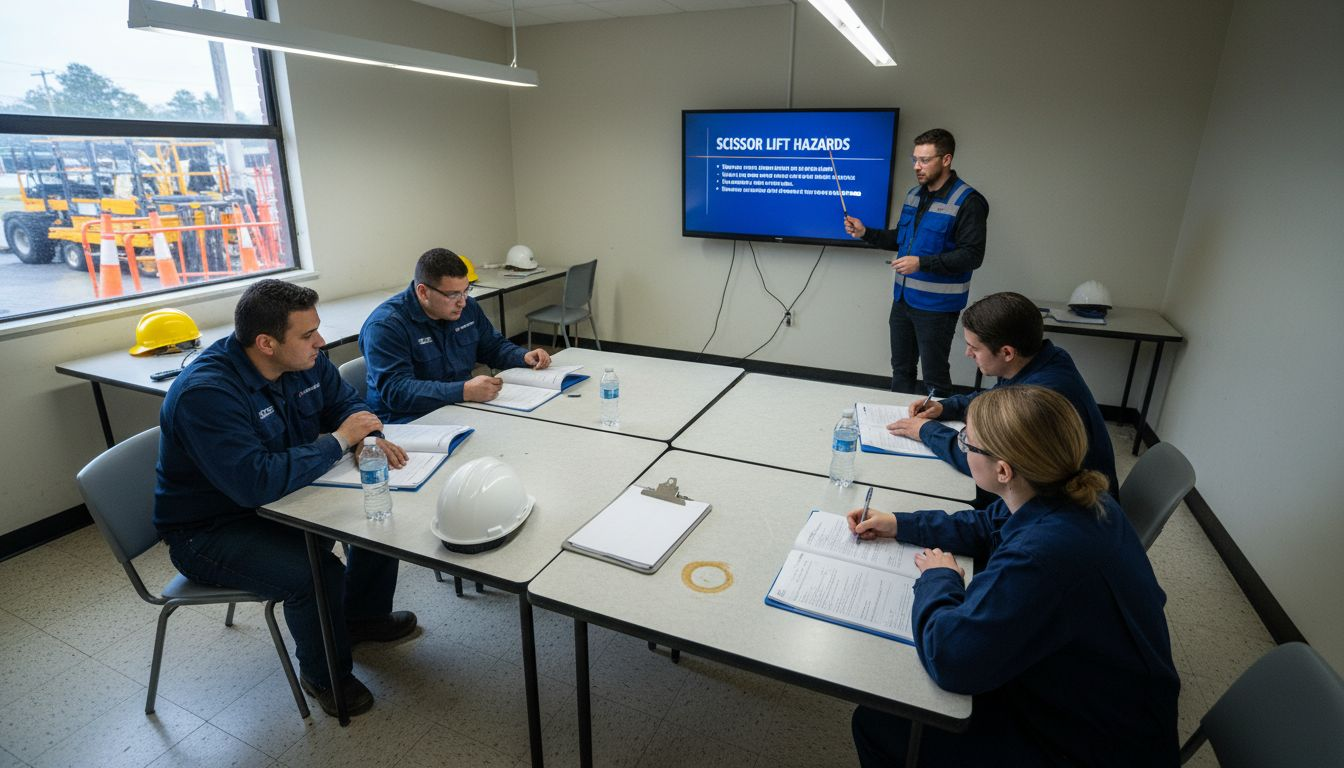
Venue selection matters more than many managers realize. Indoor training spaces work well for classroom instruction but limit hands-on practice. Outdoor areas provide realistic operating conditions but introduce weather variables and scheduling challenges. Choose locations that mirror actual work environments while maintaining safety margins for learning.
Trainee qualifications determine training depth and pacing. New operators need foundational instruction covering basic mechanics and safety principles. Experienced workers transitioning from other equipment require focused training on scissor lift-specific hazards and controls. Assess each participant’s background before designing your curriculum.
Scissor lifts handle loads up to 3.5 tons with lifting heights reaching 20 meters, creating significant hazards if misused. Understanding these technical specifications helps you emphasize load calculations and positioning during training. Operators must grasp how weight distribution affects stability and tipping risks.
Training materials should include operator manuals, safety videos, inspection checklists, and written tests. Prepare documentation templates for recording training completion, competency assessments, and authorization approvals. These records prove compliance during OSHA inspections and provide evidence of your safety commitment.
| Equipment Type | Typical Height | Load Capacity | Primary Use |
|---|---|---|---|
| Electric scissor lift | 15-30 feet | 500-1000 lbs | Indoor maintenance |
| Rough terrain scissor lift | 20-40 feet | 1000-2000 lbs | Outdoor construction |
| Narrow electric scissor lift | 15-25 feet | 500-750 lbs | Tight indoor spaces |
| Diesel scissor lift | 30-50 feet | 1500-3000 lbs | Heavy outdoor work |
Pro Tip: Schedule training during slower operational periods when you can dedicate equipment exclusively to instruction without disrupting production schedules.
Consider the benefits of online forklift training models that combine digital classroom instruction with hands-on practical sessions. This hybrid approach maximizes scheduling flexibility while ensuring operators receive required hands-on experience. Online modules cover theory and regulations, while in-person sessions focus on equipment operation and hazard recognition.
Review scissor lift technical specifications for each model in your fleet to customize training content. Generic training misses model-specific safety features and operational quirks that affect real-world performance. Operators need familiarity with their actual equipment, not theoretical knowledge of industry-standard lifts.
Executing the scissor lift training program safely and effectively
Begin every training session with pre-operation inspection instruction. Operators must learn to identify damaged components, fluid leaks, tire issues, and control malfunctions before starting equipment. Walk through each inspection point systematically, explaining what to look for and how to document findings. This habit prevents accidents caused by mechanical failures.
Follow this sequence for comprehensive operational training:
- Demonstrate control functions and emergency stops on stationary equipment
- Practice basic movements in open areas without obstacles or elevation
- Introduce load handling with progressively heavier materials within capacity limits
- Execute positioning exercises near walls, overhead obstacles, and uneven surfaces
- Simulate emergency scenarios requiring quick shutdown and descent procedures
- Conduct supervised operations in actual work environments with real tasks
Operational procedures emphasize hazard avoidance and load handling safety. Teach operators to scan work areas for overhead power lines, unstable surfaces, pedestrian traffic, and environmental conditions affecting stability. Proper scissor lift operator training significantly reduces workplace accidents by building automatic hazard recognition habits.
Fall protection use and stabilization measures prevent the majority of serious injuries. Operators must understand when guardrails alone provide sufficient protection versus when personal fall arrest systems become necessary. Demonstrate proper harness fitting, anchor point selection, and positioning that maintains fall protection while allowing necessary movement.
Pro Tip: Use colored tape to mark safe operating zones and restricted areas during training, giving visual cues that reinforce spatial awareness and boundary recognition.
Emergency response drills prepare operators for equipment failures, medical emergencies, and hazardous conditions requiring immediate evacuation. Practice emergency descent procedures until operators can execute them quickly without panic. Include scenarios like power failures, hydraulic leaks, and sudden weather changes that demand rapid response.
Validate trainee proficiency through practical exercises that mirror actual job tasks. Observation alone misses comprehension gaps that surface during hands-on performance. Create realistic scenarios requiring operators to inspect equipment, plan approaches, execute tasks, and respond to simulated emergencies. Document performance using standardized evaluation forms.
“Effective training transforms theoretical knowledge into muscle memory through repetition, correction, and progressive skill building that prepares operators for real-world challenges.”
Incorporate workplace safety training protocols that extend beyond equipment operation to include communication, teamwork, and hazard reporting. Scissor lift safety depends on coordination between operators, ground personnel, and supervisors. Train everyone involved in lift operations, not just the person at the controls.
Consult OSHA safety standards regularly to ensure your training content reflects current regulatory expectations and industry best practices. Standards evolve as new hazards emerge and technology advances. Annual curriculum reviews keep your program compliant and effective.
Verifying training outcomes and maintaining compliance
Assess operator competence through written tests covering regulations, hazard recognition, and operational procedures. Multiple choice questions verify knowledge retention while scenario-based questions evaluate judgment and decision-making abilities. Set passing thresholds at 80% or higher to ensure genuine comprehension.
Practical evaluations measure hands-on skills through observed performance of inspection, operation, and emergency procedures. Use standardized scoring rubrics that define acceptable performance for each task element. Evaluators should watch for safety violations, procedural errors, and hesitation indicating uncertainty.
Recordkeeping requirements mandate documentation of training dates, content covered, trainer qualifications, and competency assessment results. Maintain individual operator files containing certificates, test scores, and authorization approvals. Digital systems simplify record management and retrieval during inspections.
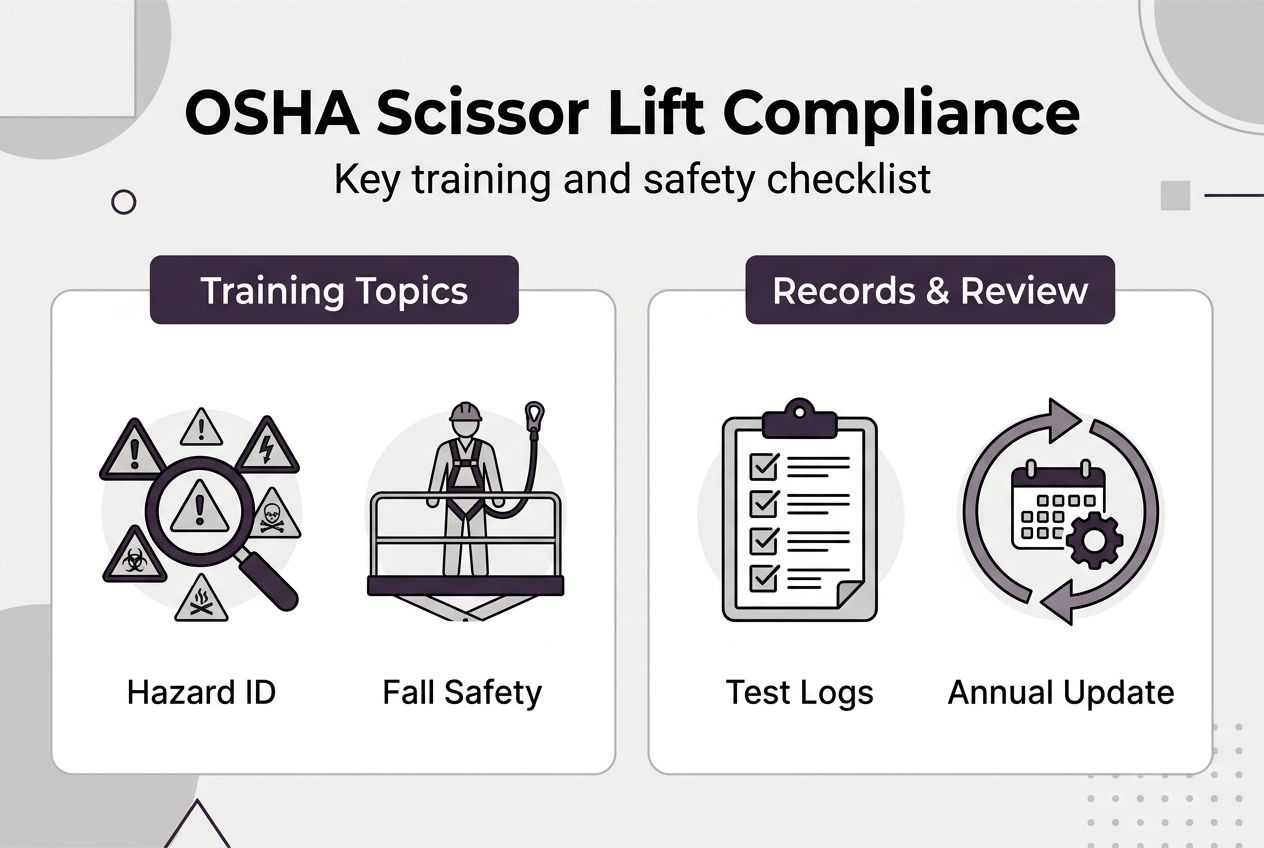
Regular refresher training addresses skill degradation, introduces updated procedures, and reinforces critical safety concepts. Annual retraining works well for most operations, though high-incident workplaces benefit from semi-annual sessions. Schedule refreshers after accidents, near-misses, or regulatory changes affecting operations.
Comparison of monitoring approaches for ongoing compliance:
| Approach | Frequency | Strengths | Limitations |
|---|---|---|---|
| Supervisor observation | Daily | Real-time correction, immediate feedback | Time-intensive, inconsistent coverage |
| Safety audits | Monthly | Systematic evaluation, trend identification | Delayed intervention, resource demands |
| Operator self-reporting | Ongoing | Encourages accountability, low cost | Relies on honesty, misses unconscious errors |
| Incident investigation | As needed | Identifies root causes, prevents recurrence | Reactive rather than preventive |
Employer responsibility extends beyond initial training to creating a safety culture where operators feel empowered to refuse unsafe tasks and report hazards without fear of retaliation. Management commitment to safety influences operator behavior more than any training program. Leaders who prioritize production over safety undermine training effectiveness.
Only trained workers should operate scissor lifts, and employers must verify competency through documented assessments. This requirement means you cannot allow untrained personnel to operate equipment even briefly or under supervision. Temporary workers, contractors, and visitors need the same training as regular employees before accessing lifts.
Implement these ongoing compliance practices:
- Quarterly safety meetings reviewing recent incidents and lessons learned
- Anonymous hazard reporting systems encouraging operator input
- Equipment maintenance logs tracking repairs and safety-related issues
- Periodic retraining triggered by accidents or procedural violations
- Management reviews of training effectiveness and incident trends
Develop relationships with OSHA compliance for businesses resources that provide updates on regulatory changes and industry best practices. Staying informed helps you adapt training programs before compliance gaps develop. Professional training providers offer expertise and materials that enhance internal programs.
Review the scissor lift safety alert periodically to understand common accident patterns and prevention strategies. Learning from industry-wide incidents improves your training content and hazard awareness. Share relevant alerts with operators during safety meetings to reinforce training concepts.
Enhance your scissor lift safety with professional training
Building an effective scissor lift training program requires expertise, time, and resources many organizations struggle to maintain internally. Superior Forklift Training offers OSHA-compliant scissor lift courses designed for warehouse managers and safety coordinators seeking proven training solutions. Our programs combine regulatory knowledge with practical instruction that prepares operators for real-world challenges.
Explore online forklift training benefits that provide scheduling flexibility without sacrificing training quality. Our hybrid model delivers comprehensive classroom instruction online while supporting hands-on practical sessions at your facility. This approach minimizes operational disruption while ensuring regulatory compliance.
Discover business training solutions tailored for companies managing multiple operators across different locations. We provide scalable programs, documentation systems, and ongoing support that simplify compliance management. Our expert instructors bring decades of experience helping organizations build safety cultures that reduce incidents and protect workers.
Invest in workplace safety training that transforms your operation through proven methods and comprehensive materials. Contact us today to discuss your scissor lift training needs and discover how professional instruction enhances safety outcomes.
Frequently asked questions
What are the key components of OSHA-compliant scissor lift training?
Comprehensive training covers hazard recognition, safe operation procedures, fall protection protocols, and emergency response techniques. Operators learn pre-operation inspections, load capacity calculations, positioning strategies, and equipment-specific controls. Training must address worksite hazards, weather conditions, and terrain challenges affecting stability. Competency verification through written tests and practical evaluations ensures operators understand and can apply safety principles.
How often should scissor lift operators undergo refresher training?
OSHA recommends annual refresher training to maintain operator competency and reinforce critical safety concepts. Organizations experiencing incidents, near-misses, or procedural changes should conduct immediate retraining regardless of schedule. High-risk environments benefit from semi-annual refreshers that address skill degradation and introduce updated best practices. Training frequency should reflect your workplace hazards, incident history, and operational complexity.
What are the most common hazards to watch for when operating a scissor lift?
Falls from elevation due to inadequate fall protection or platform instability cause the majority of serious injuries. Collisions with overhead obstacles, power lines, and structural elements create electrocution and crushing hazards. Unstable surfaces, excessive loads, and improper positioning lead to tip-overs and equipment failures. Environmental factors like wind, ice, and poor visibility increase accident risks. Operators must maintain constant awareness of surroundings and equipment limitations.
Can online training meet OSHA requirements for scissor lift operators?
Online training satisfies OSHA requirements when combined with hands-on practical instruction and competency verification. Digital modules effectively deliver regulatory knowledge, hazard recognition principles, and operational theory. However, operators must demonstrate practical skills through supervised equipment operation and evaluation. Hybrid programs offering online classroom instruction plus in-person practical sessions provide comprehensive training while maximizing scheduling flexibility and cost efficiency.
