
Get OSHA forklift certified in California: Guide 2026
Forklift accidents cause thousands of workplace injuries every year, and California employers face some of the nation’s strictest enforcement when operators lack proper certification. If you’re an operator seeking credentials or an employer managing a team, understanding the exact steps to achieve Cal/OSHA forklift compliance protects lives and prevents costly penalties. California operates under Cal/OSHA, which enforces more rigorous standards than federal OSHA, including mandatory seatbelt use, detailed recordkeeping, and penalties reaching six figures for serious violations. This guide walks you through every requirement, from eligibility checks to final evaluation, so you can certify operators correctly and maintain ongoing compliance.
Table of Contents
- Understanding Cal/OSHA Forklift Certification Requirements
- Preparing For Forklift Certification: Eligibility And Training Options
- Step-By-Step Forklift Certification Process In California
- Common Mistakes And Requirements For Recertification And Compliance
- Explore Superior Forklift Training Programs In California
- Frequently Asked Questions About OSHA Forklift Certification In California
Key takeaways
| Point | Details |
|---|---|
| Cal/OSHA stricter than federal | California enforces enhanced forklift safety rules including mandatory seatbelts, detailed records, and higher penalties than federal OSHA standards. |
| Three training components required | Operators must complete formal classroom instruction, hands-on practical training, and a final performance evaluation by a certified trainer. |
| Employers maintain detailed records | Training documentation must include operator names, dates, trainer qualifications, and equipment types, available for inspection at all times. |
| Minimum age and fitness standards | All forklift operators must be at least 18 years old and physically capable of safely operating powered industrial trucks. |
| Retraining triggers exist | Incidents, unsafe practices, new equipment, or workplace changes mandate immediate retraining to maintain certification validity. |
Understanding Cal/OSHA forklift certification requirements
California workplaces operate under Cal/OSHA regulations with stricter requirements than federal OSHA, creating unique compliance obligations for forklift operators and employers. These enhanced standards include mandatory seatbelt usage when forklifts are equipped, more detailed recordkeeping protocols, and significantly higher penalties for violations. Understanding these differences helps you avoid expensive citations and keeps your workplace safer.
Operators must meet basic eligibility criteria before beginning training. Age and physical capability requirements mandate that all forklift operators be at least 18 years old and physically fit to handle the demands of powered industrial truck operation. Employers must verify these qualifications before enrolling workers in certification programs. Physical capability includes vision, hearing, and motor skills sufficient to operate equipment safely in dynamic warehouse environments.
Training programs must cover three distinct components to satisfy Cal/OSHA Title 8 §3668 and GISO §3650 standards:
- Formal classroom instruction covering safety principles, load handling, and hazard recognition
- Practical hands-on training with actual equipment in real workplace conditions
- Performance evaluation conducted by a qualified trainer who observes operator skills
Recordkeeping requirements exceed federal standards. Employers must maintain documentation that includes operator names, training completion dates, trainer qualifications, and specific forklift types covered. These records must be readily accessible for Cal/OSHA inspectors during workplace visits. Missing or incomplete documentation triggers immediate citations, even if operators demonstrate competent skills.
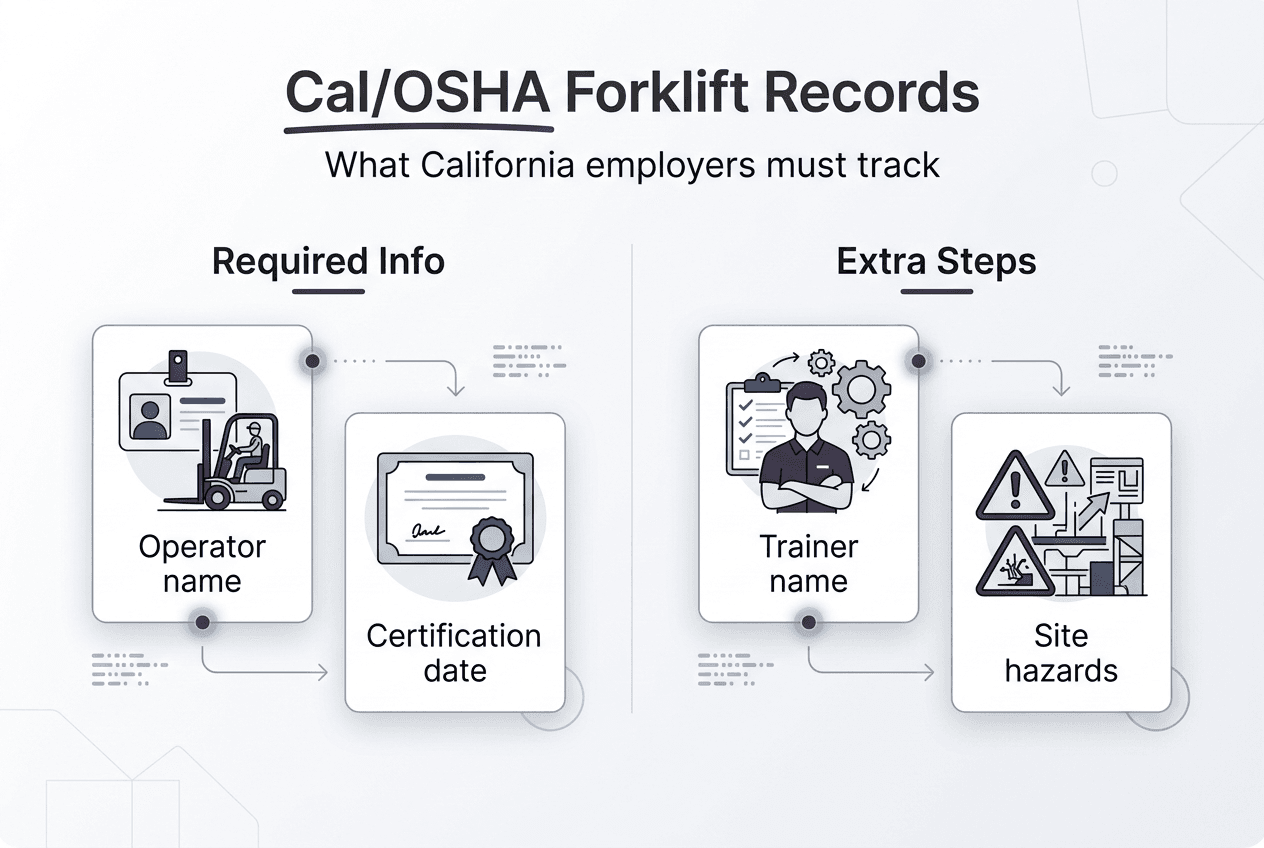
Pro Tip: Store training records both digitally and in physical files at the worksite to ensure immediate access during surprise inspections, reducing compliance risk.
Penalty structures in California carry serious financial consequences. Willful violations can result in fines reaching $162,851 per incident, while serious violations typically cost $25,000 or more. These penalties apply to each untrained operator or missing record, meaning costs multiply quickly across larger workforces. The benefits of proper forklift training extend far beyond avoiding fines, creating safer work environments that reduce injury rates and workers’ compensation claims.
Cal/OSHA’s enhanced enforcement means California employers face higher scrutiny and steeper penalties than counterparts in other states, making thorough compliance essential rather than optional.
Preparing for forklift certification: eligibility and training options
Before enrolling in any training program, verify that prospective operators meet all eligibility prerequisites. The 18-year minimum age requirement applies universally across California, with no exceptions for younger workers even under supervision. Physical capability assessments should evaluate vision, hearing, balance, and strength to ensure candidates can safely control equipment weighing several tons. Medical conditions affecting reaction time or spatial awareness may disqualify candidates from certification.
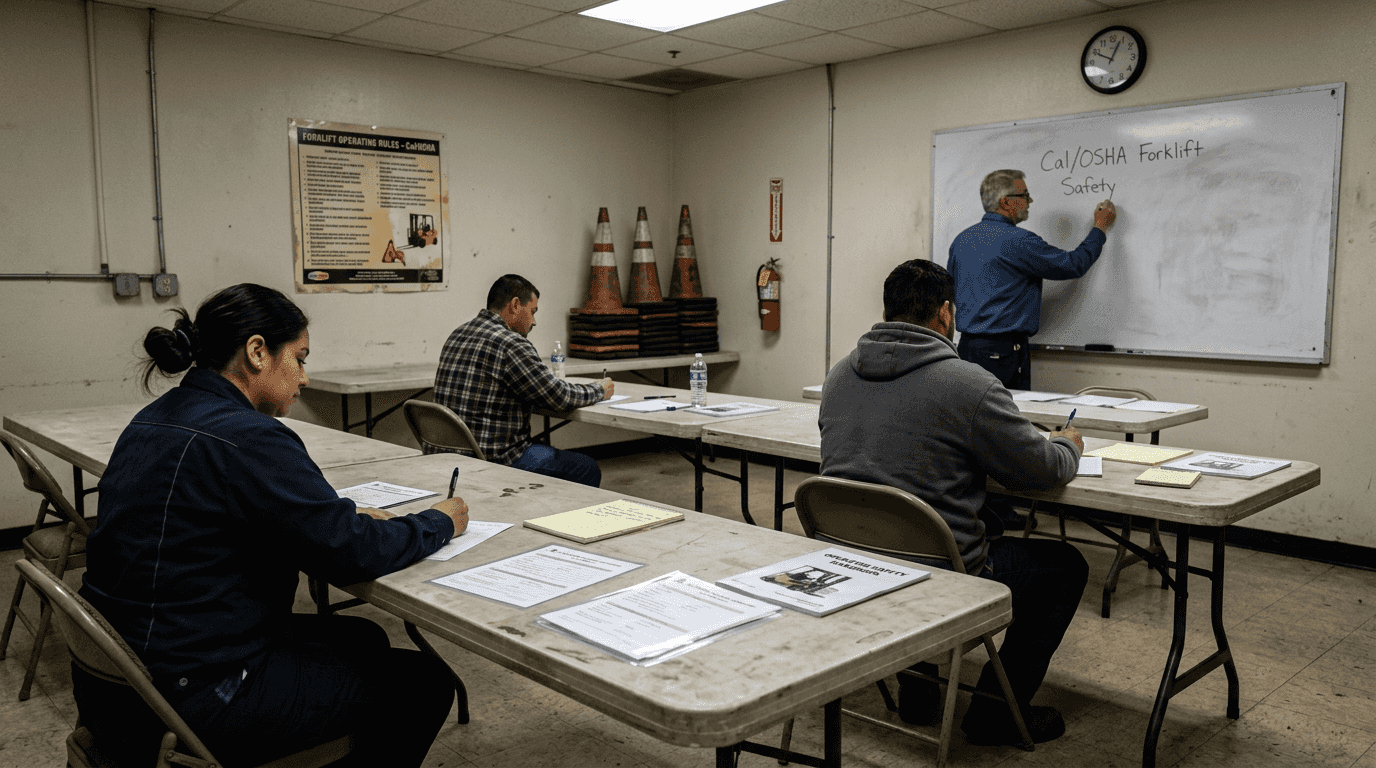
Employers choosing training pathways have several effective options. Train-the-trainer and onsite group programs offer efficiency for companies certifying multiple operators simultaneously. Train-the-trainer approaches allow experienced supervisors to become certified instructors, enabling ongoing internal training without recurring third-party costs. Onsite group training brings instructors to your facility, customizing content to your specific equipment and workplace hazards.
Third-party providers deliver flexibility for both individuals and businesses. Independent operators seeking certification can enroll in programs without employer sponsorship, though they still require employer evaluation before operating equipment at any worksite. Businesses benefit from third-party expertise when internal resources lack qualified trainers or when certification timelines demand immediate solutions. Online components combined with in-person evaluations accelerate the process while maintaining compliance.
Certification validity lasts three years from the completion date, after which operators must undergo recertification. This timeline applies to routine renewals when no incidents or workplace changes occur. However, certain triggers mandate immediate retraining regardless of how recently an operator certified. Planning recertification schedules prevents gaps in operator availability and maintains continuous compliance across your workforce.
Selecting programs that address both Cal/OSHA regulations and site-specific hazards proves critical. Generic training covering only federal OSHA standards leaves gaps in California compliance, particularly around seatbelt requirements and recordkeeping details. Effective programs incorporate your facility’s unique challenges, such as narrow aisles, ramp operations, or specialized attachments. Customization ensures operators gain practical skills directly applicable to their daily responsibilities.
Pro Tip: Schedule training during slower operational periods to allow thorough practice time without production pressure, improving skill retention and evaluation success rates.
Training options for different needs:
- Individual certification programs for operators seeking credentials independently
- Business training solutions for employers certifying entire teams efficiently
- Hybrid online and in-person formats combining convenience with hands-on evaluation
- Spanish language options ensuring comprehension for diverse workforces
Budget considerations vary by approach. Individual certification through third-party providers typically costs less than employer-sponsored programs but requires coordination with current or prospective employers for final evaluation. Bulk business programs offer per-operator discounts when certifying larger groups. Calculate total costs including instructor time, equipment downtime during training, and potential productivity impacts when comparing options.
Step-by-step forklift certification process in California
Following a structured certification process ensures compliance and prevents costly oversights. Each step builds on the previous one, creating a comprehensive pathway from eligibility verification through final documentation.
-
Confirm operator eligibility requirements. Verify the candidate is at least 18 years old through government-issued identification. Assess physical and mental fitness through observation or medical evaluation, ensuring the operator can safely handle equipment. Document this eligibility verification in your training records as evidence of due diligence.
-
Complete formal classroom instruction. Operators must receive structured education covering forklift physics, load capacity calculations, stability principles, and hazard recognition. Classroom sessions typically span four to eight hours depending on program depth. Content must address California-specific requirements including mandatory seatbelt use and enhanced inspection protocols.
-
Conduct practical hands-on training. Trainees operate actual forklifts under direct supervision, practicing maneuvers like load pickup, stacking, traveling, and parking. Training should occur in the actual work environment or conditions closely matching it. Operators must demonstrate proficiency with the specific forklift types they will operate, as certification does not transfer across all equipment classes.
-
Undergo formal performance evaluation. A certified trainer observes the operator performing required tasks and assesses competency against established criteria. Employers maintain responsibility for evaluation and cannot delegate this to uncertified personnel. The evaluator documents performance, noting any deficiencies requiring additional training before certification.
-
Employer creates and maintains detailed records. Documentation must include operator name, training completion dates, trainer qualifications, and forklift types covered. Records remain accessible at the worksite for immediate inspector review. Digital backups provide redundancy but do not replace the requirement for onsite physical copies.
-
Implement daily pre-shift inspection procedures. Cal/OSHA mandates operators complete safety checks before each shift, examining brakes, steering, controls, warning devices, and mast operation. Inspection checklists create documentation trails proving consistent compliance. Any defects discovered must be reported immediately and equipment tagged out of service until repairs complete.
-
Schedule retraining for triggering events. Incidents, near misses, observed unsafe practices, new equipment introductions, or workplace layout changes all require immediate retraining. This retraining follows the same three-component structure as initial certification, ensuring operators adapt to new conditions safely.
Pro Tip: Create a certification tracking spreadsheet noting each operator’s certification date and three-year expiration, setting reminders six months before expiration to schedule recertification without workforce disruptions.
| Certification Step | Responsible Party | Timeframe | Documentation Required |
|---|---|---|---|
| Eligibility verification | Employer | Before training | Age proof, fitness assessment |
| Classroom instruction | Trainer/Provider | 4-8 hours | Attendance records, curriculum |
| Practical training | Trainer/Employer | 8-16 hours | Practice logs, equipment types |
| Performance evaluation | Certified Trainer | 1-2 hours | Evaluation forms, pass/fail results |
| Record maintenance | Employer | Ongoing/3 years | Complete training files |
| Daily inspections | Operator | Every shift | Inspection checklists |
The forklift safety training process requires coordination between multiple parties but ultimately rests on employer shoulders. Even when using third-party trainers, employers retain legal responsibility for ensuring operators receive complete, compliant instruction. This shared accountability model protects workers while clarifying enforcement targets during Cal/OSHA investigations.
Common mistakes and requirements for recertification and compliance
Many California employers stumble over preventable compliance errors that trigger citations during inspections. Understanding these pitfalls helps you maintain continuous compliance and avoid unnecessary penalties.
Inadequate recordkeeping ranks as the most frequent violation. Employers often maintain basic certification cards but lack the detailed documentation Cal/OSHA requires. Missing trainer qualifications, incomplete equipment type specifications, or absent training dates each constitute separate violations. Inspectors specifically request these records during site visits, and inability to produce them immediately results in citations regardless of actual operator competency.
Neglecting daily pre-shift inspections creates both safety hazards and compliance gaps. Daily inspection requirements mandate operators check critical systems before each shift, documenting findings on standardized checklists. Skipping inspections to save time exposes workers to equipment failures and employers to liability. Incomplete or missing inspection records signal systematic safety failures to regulators, often triggering broader workplace investigations.
Retraining triggers catch employers off guard when incidents occur. Any accident, near miss, or observed unsafe practice mandates immediate retraining before the operator returns to forklift duties. Equipment changes, including new forklift models or attachment types, also require retraining even if operators hold current certifications. Workplace modifications like new racking systems, revised traffic patterns, or altered loading areas similarly trigger retraining obligations.
Common compliance mistakes:
- Assuming federal OSHA training suffices without addressing Cal/OSHA enhancements
- Failing to retrain after incidents or equipment changes
- Using uncertified trainers to conduct evaluations
- Neglecting seatbelt requirements on equipped forklifts
- Missing documentation of trainer qualifications in training records
Seatbelt oversights represent a uniquely California concern. While federal OSHA recommends seatbelt use, Cal/OSHA mandates it when forklifts include seatbelt equipment. Operators removing or disabling seatbelts, or simply failing to use them, create per-instance violations. Training must explicitly cover this requirement, and supervisors must enforce it consistently.
| Violation Type | Federal OSHA Penalty | Cal/OSHA Penalty | Key Difference |
|---|---|---|---|
| Serious violation | Up to $16,131 | Up to $25,000 | 55% higher California penalty |
| Willful violation | Up to $161,323 | Up to $162,851 | Marginally higher but enforced more strictly |
| Recordkeeping failure | Up to $16,131 | Up to $25,000 | California requires more detailed records |
| Repeat violation | Up to $161,323 | Up to $162,851 | California tracks violations more aggressively |
Penalty comparison reveals California’s enhanced enforcement posture. Beyond higher dollar amounts, Cal/OSHA conducts more frequent inspections and pursues violations more aggressively than federal counterparts. This creates elevated risk for California employers, making proactive compliance more cost-effective than reactive penalty management.
Maintaining ongoing compliance requires systematic approaches. Designate a safety coordinator responsible for tracking certifications, scheduling retraining, and maintaining records. Implement regular internal audits reviewing documentation completeness and inspection consistency. The forklift safety compliance resources available through specialized providers help employers stay current with regulatory changes and best practices.
Pro Tip: Conduct quarterly self-audits using Cal/OSHA’s inspection checklist to identify and correct compliance gaps before regulators arrive, significantly reducing citation risk.
Explore superior forklift training programs in California
Navigating California’s complex forklift certification requirements becomes straightforward with the right training partner. Superior Forklift Training delivers programs specifically designed to meet Cal/OSHA standards while offering the flexibility modern workplaces demand. Whether you’re an individual seeking certification or an employer training entire teams, their tailored solutions simplify compliance.
Their platform combines online convenience with thorough compliance support, allowing operators to complete classroom components remotely before hands-on evaluation. Business training solutions accommodate bulk certifications efficiently, reducing per-operator costs while maintaining quality instruction. Comprehensive recordkeeping tools automatically generate the detailed documentation Cal/OSHA inspectors require, eliminating common compliance gaps. Explore the benefits of online forklift training to see how flexible scheduling and expert instruction accelerate your certification timeline while ensuring full regulatory compliance.
Frequently asked questions about OSHA forklift certification in California
How long is forklift certification valid in California?
Forklift certification remains valid for three years from the completion date under normal circumstances. However, incidents, unsafe practices, new equipment, or workplace changes trigger immediate retraining requirements regardless of certification age. Employers must track expiration dates and schedule recertification before credentials lapse to maintain continuous operator authorization.
Can an individual get certified without an employer?
Individuals can complete classroom and practical training components through third-party providers independently. However, Cal/OSHA requires employer-conducted performance evaluation before operators can legally operate forklifts at any worksite. Self-certification without employer involvement does not satisfy legal requirements, making employer partnership essential for valid credentials.
What triggers mandatory retraining?
Retraining becomes mandatory after workplace accidents or near misses involving the operator, observation of unsafe operating practices, introduction of new forklift types or attachments, and significant workplace changes affecting forklift operations. Employers must document retraining completion before allowing operators to resume forklift duties following any triggering event.
Are daily inspections legally required?
Cal/OSHA regulations mandate daily pre-shift inspections covering brakes, steering, controls, warning devices, and lift mechanisms. Operators must complete standardized checklists documenting inspection results and immediately report any defects. Equipment with identified safety issues must be tagged out of service until qualified maintenance personnel complete repairs and document corrections.
What are the penalty risks for non-compliance?
California employers face penalties up to $25,000 for serious violations and $162,851 for willful offenses per incident. Violations multiply across untrained operators or missing records, potentially reaching hundreds of thousands in total fines. Beyond monetary penalties, serious violations can trigger operational shutdowns, increased inspection frequency, and criminal liability in cases involving worker fatalities or severe injuries.
